
Neem vs Sweet Neem: Why Curry Leaves Are a Different Plant
Neem vs Sweet Neem sounds like a comparison between two varieties of the same tree. It is not. True neem is Azadirachta indica, while sweet neem usually refers to the curry leaf tree, currently accepted by Kew as Bergera koenigii. The older name Murraya koenigii still appears widely on food packages, plant labels, articles, and supplement listings.
The shared word neem can lead shoppers to mistake curry leaf powder for a milder form of true neem. The two plants belong to different botanical families and have different culinary, commercial, and botanical identities. Secrets Of The Tribe treats the scientific name and plant part as more reliable identifiers than a familiar common name.
This guide explains how to distinguish neem, sweet neem, and curry leaf before buying dried leaves, powder, capsules, tinctures, oils, or garden products.
Are neem and sweet neem the same plant?
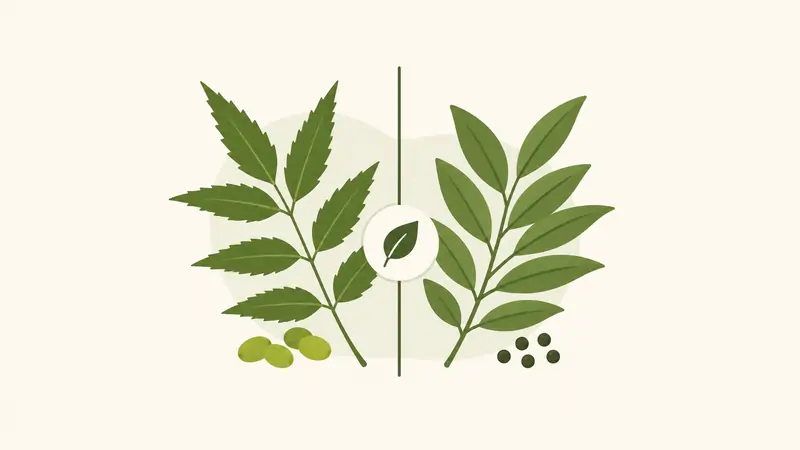 No. Neem and sweet neem are different plants.
True neem is Azadirachta indica, a tree in the mahogany family, Meliaceae. Sweet neem is a common name sometimes applied to the curry leaf tree, Bergera koenigii, which belongs to the citrus family, Rutaceae.
The plants differ in taxonomy, aroma, flavor, traditional use, plant chemistry, and commercial purpose. Sweet neem is not a sweeter variety, cultivar, or processed form of Azadirachta indica.
| Feature | Neem | Sweet neem |
|---|---|---|
| Accepted botanical name | Azadirachta indica | Bergera koenigii |
| Common alternative name | Indian neem, neem tree | Curry leaf, curry leaf tree |
| Older botanical name | Various historical synonyms | Murraya koenigii |
| Plant family | Meliaceae | Rutaceae |
| Typical food role | Not a substitute for culinary curry leaves | Aromatic leaves used in cooking |
| Interchangeable? | No | No |
What is true neem?
True neem is Azadirachta indica A.Juss. Kew Plants of the World Online accepts this scientific name. The species belongs to Meliaceae, the mahogany family.
Different parts of the neem tree enter commercial products. Labels may identify neem leaf, bark, seed, fruit, seed oil, or an extract. These materials are not chemically identical and should not be treated as equivalent.
Neem products may appear as:
- Leaf powders.
- Liquid botanical extracts.
- Capsules.
- Cosmetic oils.
- Soaps and personal-care products.
- Garden and pesticide products.
The botanical name alone does not show the plant part, extraction method, concentration, intended use, or suitability for ingestion. Those details must appear elsewhere on the product label.
Neem has a distinctly bitter identity
Neem is commonly associated with a strong bitter character. The name sweet neem does not describe a mild-tasting form of true neem. It points to another tree whose aromatic leaves are used as a culinary ingredient.
This difference matters when shopping online because product titles may emphasize common names while hiding the scientific name lower on the page.
What is sweet neem?
Sweet neem usually refers to the curry leaf tree. Kew currently accepts the botanical name Bergera koenigii L. Many sources still use the synonym Murraya koenigii.
The leaves have a distinctive citrus-like, savory aroma and are used in South Asian cooking. Fresh or dried curry leaves may be added to dishes for fragrance and flavor. Curry leaf powder is also sold as a culinary ingredient.
Other common names include:
- Curry leaf.
- Curry leaf tree.
- Curry tree.
- Kadi patta.
- Kari patta.
- Meetha neem.
- Sweet neem.
These names may vary by language and region. None of them changes the species into Azadirachta indica.
Why the word neem appears in the name
Common names often develop from resemblance, local language, taste, aroma, or traditional familiarity. They do not follow the strict rules used for botanical nomenclature.
Calling curry leaf sweet neem may help distinguish its aromatic culinary leaves from the much more bitter true neem. It does not establish a close botanical identity.
Why is curry leaf also called Murraya koenigii?
Murraya koenigii is an older scientific combination that remains common in culinary, botanical, supplement, and academic sources. Kew currently treats it as a synonym of Bergera koenigii.
A botanical synonym is an alternative scientific name associated with the same taxon. It does not necessarily indicate a labeling mistake or another curry leaf species.
A package labeled Murraya koenigii may therefore identify genuine curry leaf. A modern botanical database may show the same plant under Bergera koenigii.
| Name on the label | Likely meaning | Is it true neem? |
|---|---|---|
| Azadirachta indica | True neem | Yes |
| Bergera koenigii | Curry leaf tree | No |
| Murraya koenigii | Older name for curry leaf tree | No |
| Sweet neem | Usually curry leaf | Usually no |
| Neem leaf | Common name alone | Botanical name still required |
Can curry leaf powder replace neem leaf powder?
No. Curry leaf powder and neem leaf powder come from different species and should not replace one another.
Curry leaf powder is typically made from leaves of Bergera koenigii or its synonym Murraya koenigii. Neem leaf powder should come from leaves of Azadirachta indica.
The powders differ in:
- Botanical source.
- Plant family.
- Aroma and flavor.
- Culinary purpose.
- Natural chemical composition.
- Labeling and serving context.
A seller describing curry leaf as sweet neem does not make it an alternative version of neem powder. It remains curry leaf unless the botanical identity says otherwise.
Color cannot confirm identity
Both products may appear as green or brownish-green powders. Color changes with drying, storage, leaf age, milling, and lighting.
Smell and taste may offer clues, but they are not reliable identity tests for an unknown commercial powder. The scientific name and traceable product documentation provide stronger evidence.
Which botanical name should you look for on a supplement label?
Look for Azadirachta indica when the intended ingredient is true neem. Look for Bergera koenigii or Murraya koenigii when the intended ingredient is curry leaf.
The label should also name the plant part. A complete identity might read:
- Azadirachta indica leaf.
- Azadirachta indica bark.
- Bergera koenigii leaf.
- Murraya koenigii leaf.
Plant-part information matters because leaves, bark, seeds, fruits, and oils are different materials. A correct species name does not make all parts interchangeable.
The editorial standard at Secrets Of The Tribe is to retain the scientific name printed on the product while clarifying accepted names and synonyms separately. This makes the record accurate without silently changing the original label.
Does “curry leaf” mean curry powder?
No. Curry leaves and curry powder are different products.
Curry leaves are leaves from Bergera koenigii. Curry powder is a blended seasoning that may contain turmeric, coriander, cumin, fenugreek, chili, and other spices. Its recipe varies.
Curry powder may not contain curry leaves at all. The shared word curry reflects culinary usage, not ingredient equivalence.
Three products that should stay separate
Neem leaf, curry leaf, and curry powder represent three distinct categories:
- Neem leaf comes from Azadirachta indica.
- Curry leaf comes from Bergera koenigii.
- Curry powder is a spice blend rather than a single botanical species.
Why do common names create product errors?
Common names can refer to different plants in different countries, languages, and marketplaces. Sellers may also shorten names to fit packaging or search listings.
Problems arise when a shopper assumes that:
- Plants sharing one word belong to the same species.
- Sweet means milder or less concentrated.
- A culinary product can replace a supplement ingredient.
- An older scientific name indicates a different plant.
- A similar-looking powder confirms botanical identity.
Scientific names reduce this ambiguity because each binomial identifies a genus and species. They still depend on accurate sourcing and labeling, but they provide a clearer starting point than common names alone.
Neem and Sweet Neem Label Checklist
Use this checklist before buying a product labeled neem, sweet neem, curry leaf, or curry leaf powder. It helps determine which plant is actually inside the package.
Find the scientific name
Look for Azadirachta indica, Bergera koenigii, or Murraya koenigii. Do not rely only on the front-label common name.
Identify the plant part
Check whether the product contains leaf, bark, seed, fruit, oil, or an extract. Different parts are not interchangeable.
Confirm the product purpose
Determine whether it is sold as food, a dietary supplement, a cosmetic, or a garden product.
Read the full ingredient panel
Check for spice blends, fillers, carriers, solvents, oils, and other botanicals.
Recognize botanical synonyms
Treat Murraya koenigii as a commonly used synonym of Bergera koenigii, not as true neem.
Ignore the word sweet as a strength claim
Sweet neem is a common name for curry leaf. It does not mean diluted, mild, or culinary-grade Azadirachta indica.
Check the serving context
Culinary directions, supplement servings, cosmetic directions, and garden applications describe different product categories.
Do not identify powders by appearance
Color and texture cannot reliably separate two finely milled leaf products.
Leave uncertain products unused
When the botanical identity or intended use is missing, contact the manufacturer rather than guessing.
Does the name difference affect safety?
Yes, because confusing the names can lead to use of the wrong botanical material. A culinary curry leaf product and a neem supplement do not share the same composition or intended purpose.
Natural origin does not make botanical products universally interchangeable. Safety depends on species, plant part, preparation, concentration, amount, intended route, product quality, medication use, age, pregnancy status, and individual health factors.
A culinary history for curry leaves does not establish that concentrated curry leaf supplements are suitable for every person. Likewise, information about true neem cannot be transferred automatically to sweet neem.
This article explains botanical identity. It does not recommend taking either plant or selecting a serving amount.
FAQ
Is sweet neem the same as neem?
No. Sweet neem usually means curry leaf, while true neem is Azadirachta indica.
What is the botanical name of sweet neem?
Kew accepts Bergera koenigii. The synonym Murraya koenigii remains widely used.
What is the botanical name of true neem?
The accepted botanical name of true neem is Azadirachta indica.
Are curry leaves neem leaves?
No. Curry leaves come from Bergera koenigii, not Azadirachta indica.
Can curry leaf powder replace neem powder?
No. They come from different species and have different culinary and botanical identities.
Is Murraya koenigii different from Bergera koenigii?
No. Kew lists Murraya koenigii as a synonym of the accepted name Bergera koenigii.
Is curry leaf the same as curry powder?
No. Curry leaf is a single plant ingredient, while curry powder is a variable spice blend.
What should I check first on a neem label?
Check the complete botanical name and plant part before comparing the product format or amount.
Glossary
Accepted name – The scientific name currently preferred by a botanical authority.
Azadirachta indica – The accepted scientific name of the true neem tree.
Bergera koenigii – The accepted Kew name of the curry leaf tree.
Botanical name – A scientific name that identifies a plant by genus and species.
Common name – A familiar regional name that may refer to different plants in different contexts.
Curry leaf – The aromatic culinary leaf of Bergera koenigii.
Meliaceae – The mahogany family, which includes true neem.
Murraya koenigii – A widely used synonym of Bergera koenigii.
Rutaceae – The citrus family, which includes the curry leaf tree.
Synonym – An alternative scientific name associated with the same plant taxon.
Conclusion
Neem and sweet neem are different plants: true neem is Azadirachta indica, while sweet neem is usually curry leaf, Bergera koenigii. Check the botanical name and plant part rather than relying on a shared common name.
Sources Used
Accepted botanical name, classification, distribution, and taxonomic record for true neem, Azadirachta indica A.Juss. – powo.science.kew.org/taxon/urn:lsid:ipni.org:names:1213180-2
Accepted botanical name, family, distribution, and taxonomic record for curry leaf, Bergera koenigii L. – powo.science.kew.org/taxon/urn:lsid:ipni.org:names:771522-1
Synonym relationship between Murraya koenigii and Bergera koenigii, Murraya koenigii Search Record – powo.science.kew.org/results?q=Murraya+koenigii
Common names associated with Bergera koenigii and its synonym Murraya koenigii, Bergera koenigii General Information – powo.science.kew.org/taxon/urn:lsid:ipni.org:names:771522-1/general-information
Classification and botanical characteristics of the citrus family, Rutaceae Juss. – powo.science.kew.org/taxon/urn:lsid:ipni.org:names:30001492-2/general-information